


Granite Falls in Rocky Mountain National Park
Granite Falls takes a 5.1 mile journey from the Green Mountain Trailhead in Rocky Mountain National Park. At Granite Falls, the waters of Tonahutu Creek drop fifty feet through a course of smooth granite slabs. The hike offers a diverse landscape: from tranquil forests, to expansive meadows, and verdant creeksides--all alive with wildflowers and wildlife. Explore the full Granite Falls hike profile below for trail map, driving directions, and more tips and details to help you enjoy this adventure in Rocky Mountain National Park.
Note: Rocky Mountain National Park now requires timed entry permits from May 27th through October 10th. See the RMNP permits page for more information.
Trail Snapshot: Granite Falls Hike in Rocky Mountain National Park
| Hike Distance | 10.2 miles Round Trip |
|---|---|
| Difficulty | Moderate |
| Duration | Approx 5 to 7 hr Round Trip |
| Trail Type | Out and Back |
| Starting Elevation | 8800' |
| Elevation Gain | Approx. +940' |
| Seasons | Spring through Fall |
| Dogs | Prohibited in RMNP |
| Hike Trail Map | Click for a Map of Granite Falls RMNP |
| Denver Drive Time | 2 hr |
| Driving Directions to Green Mountain Trailhead | Click for Google Map |
| Town Nearest Hike | Grand Lake, Colorado |
| Beauty | Waterfall, pine, aspen, mountain views, wildlife: Abert’s squirrel, elk, deer, moose, bear; wildflowers |
| Activities | Picnicking, hiking trails, snowshoeing, horseback riding, backcountry camping (with a permit), photography |
| Fee | Park Pass Required |
Parking & Trailhead Information for Granite Falls
The Green Mountain Trailhead is located on the western side area of Rocky Mountain National Park, north of Grand Lake, Colorado, along Trail Ridge Road. From the Kawuneeche Visitor Center in Grand Lake, drive 3 miles north on Trail Ridge Road. The Green Mountain Trailhead will be on the right/east side of the road, and has a capacity for around 25 vehicles.
The Hike: Granite Falls Trail in RMNP
The hike begins at the Green Mountain Trailhead and follows the Green Mountain Trail for 1.9 miles to Big Meadows, and encounters the first trail junction. The way to Granite Falls is to take the left-hand trail for 0.7 mile that skirts the western border of Big Meadows. There is a group campsite in Big Meadows that offers some of the most spectacular views of the night sky. Moose and elk frequent this area and brook trout can be found in nearby Tonahutu Creek.
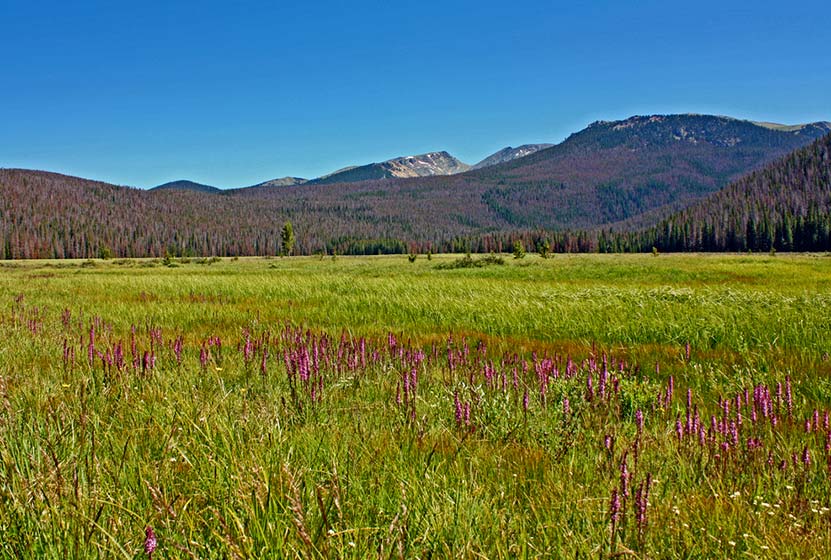
At 2.6 miles, the trail meets a second trail junction. The way to Granite Falls is to go right/east on the Tonahutu trail towards Flattop Mountain. Because their is only a 1000' elevation gain over the course of the 5.1 miles to Granite Falls, the trail only has a mild and undulating slope. After crossing two creeks, a small sign will point the way down a spur trail that leads to Granite Falls. The waterfall is a series of slide cascades flowing over broad granite slabs into a pool of swirling waters. The hike back follows the same route, making this a 10.2 mile out-and-back hike.
Tips & Resources for Hiking to Granite Falls in RMNP
- Prepare: Bring lots of water and high-energy food for this longer 10.2 mile hike.
- Trail Map for Kawuneeche Valley: Trail Map Link
- Packing List: Always pack the 10 Essentials. Download our Hiking Guide to get list and dayhiking packing checklist.
- Colorado Road Conditions: Colorado Road Conditions
- Photo: We would like to express our gratitude to Will Currier for sharing such an amazing photograph of this hike to Granite Falls in RMNP.
- After the Hike: Fat Cat Cafe It may be the best breakfast in Colorado!
Weather
Map & Driving Directions
Click for Driving Directions

Pear Lake Hike in Rocky Mountain National Park
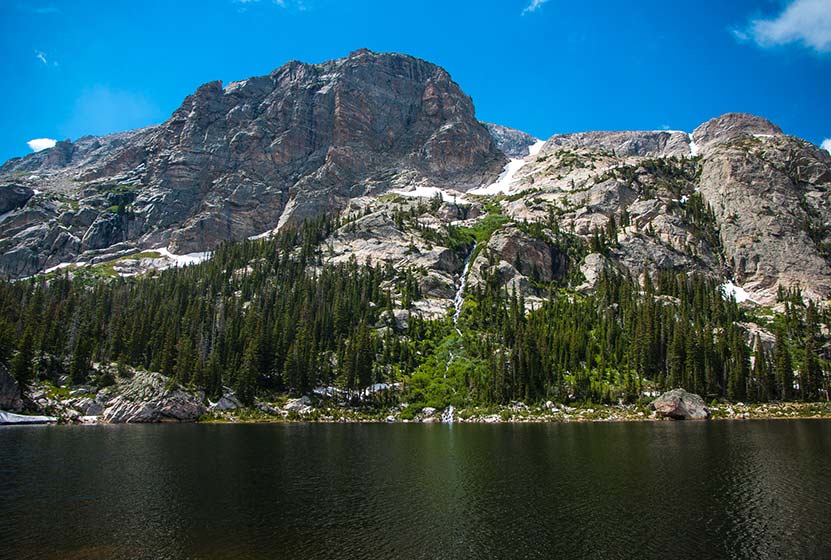
Pear Lake is a great destination for solitude, fishing, and mountain views. It's a 6.5 mile, demanding hike through some of the best wildflower country in Rocky Mountain National Park. After passing Finch Lake, the trail makes its way to the higher, Pear Lake where Copeland Mountain appears to shoot straight from its shores into the sky. Explore the full Pear Lake hike profile below for trail map, driving directions, and more tips and details to help you enjoy this adventure in Rocky Mountain National Park.
Note: Rocky Mountain National Park now requires timed entry permits from May 27th through October 10th. See the RMNP permits page for more information.
Trail Snapshot: Pear Lake in Rocky Mountain National Park
| Hike Distance | 13 miles Round Trip |
|---|---|
| Difficulty | Difficult |
| Duration | Approx 7-8 hr Round Trip |
| Trail Type | Out and Back |
| Starting Elevation | 8470′ |
| Elevation Gain | Approx +2112′ |
| Seasons | Spring through Fall, Winter Snowshoeing |
| Dogs | Prohibited in RMNP |
| Hike Trail Map | Click for a Map of Pear Lake RMNP |
| Denver Drive Time | 1 hr 30 min |
| Driving Directions to Finch Lake Trailhead | Click for Google Map |
| Town Nearest Hike | Allenspark, Colorado |
| Beauty | Waterfall, mountain views, meadows, aspen, river, wildlife: blue dragonfly, jackrabbit, mallard, Abert’s squirrel, elk, deer, moose, bear; wildflowers |
| Activities | Picnicking, hiking trails, fishing, snowshoeing, horseback riding, backcountry camping (with a permit), photography |
| Fee | Park Pass Required |
Parking & Trailhead Information for Pear Lake
The hike to Pear Lake begins at the the Finch Lake Trailhead, located approximately 1/5th of a mile east of the larger Wild Basin Trailhead near Allenspark, Colorado. Because there is very limited parking at the Finch Lake Trailhead, most hikers will need to park at the Wild Basin Trailhead and add the 1000' feet of trail between the Wild Basin Trailhead and the Finch Lake Trailhead to their journey. There is an alternative approach via the Allenspark Trailhead. However, the route described in this trail profile will be from the Finch Lake Trailhead nearest to the Wild Basin Trailhead.
- Map and Driving Directions to the Finch Lake Trailhead
- Map and Driving Directions to the Wild Basin Trailhead
The Hike: Pear Lake Trail in RMNP
The hike up to Pear Lake is a steady climb through a forest of pine, aspen, spruce, and meadows laden with wildflowers. It's a demanding hike from the outset, coursing up a set of switchbacks to gain the ridge of a lateral moraine. After this initial east bearing segment, the trail turns back to the west begins a gentle descent through one of Rocky Mountain National Park's most stunning displays of wildflowers. Near the bottom of the moraine, near Fox Creek, the trail encounters its first junction. The the trail to the right/west leads towards both Finch and Pear lakes (the left/east trail leads to the Allenspark Trailhead). Climbing higher, the trail will pass an overlook with views of the distant mountain peaks of Pagoda, Meeker, and Chief's Head, as well as views of the greater Wild Basin area.
The next trail junction--at approx. 2.5 miles--has been named "Confusion Junction" because of its power to confound hikers. Pause and study the trail signage in order to choose the correct trail. The correct way is the trail labeled "Pear Lake" and/or "Finch Lake."
After approximately 1/4 mile, the trail passes through a burn area from the 1978 fire, which has made a good recovery and is now riddled with summer wildflowers. Continuing to work uphill, the trail makes several stream crossings before a descent to Finch lake, which begins at 3.8 miles. Then, at approximately 4.25 miles, the trail makes a hard right-turn. This part of the trail is often obscured by snow as late as as midsummer and early as the first signs of autumn.
At Finch Lake the trail wraps around the eastern edge, then the northern shore of the lake. The next segment of trail, from Finch Lake to Pear Lake is approximately 2 miles. These are steep and demanding. Winter snows last into the early months of summer. July brings an incredible display of wildflowers in both the forest and meadows, and the abundance of moisture and vegetation makes this broad valley a great place for viewing wildlife.
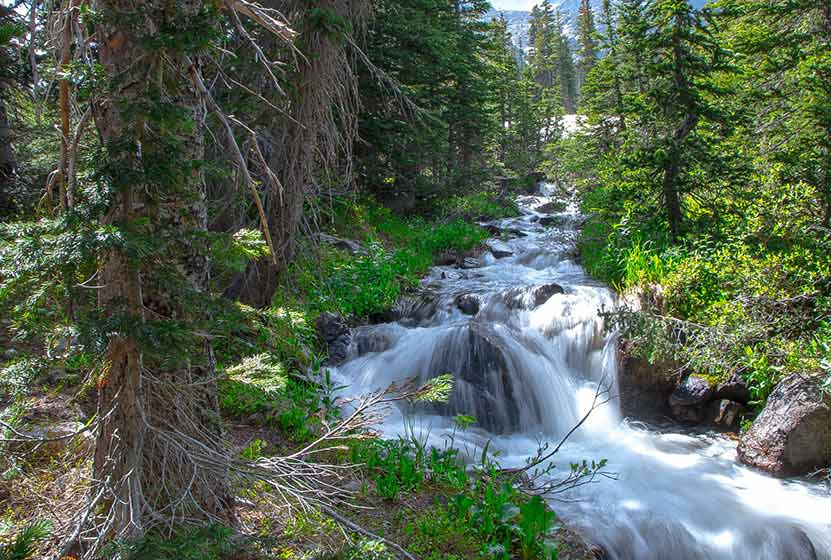
At approximately 6 miles, the trail will cross pear creek. The forest then gives way to rock and eventually to Pear Lake. Pear Lake is enclosed by a ring of rock and mountain. The rugged rock and cliffs of Copeland Mountain come down to meet the northwestern shores. In the early hours of morning, the images Copeland Mountain and Ouzel peak can be seen mirrored in the lake.
Pear Lake is a great place to fish and is catch and release only. A fishing license is required and State and Park fishing regulations apply. There are two campsites near Pear Lake: Pear Creek (just below the lake), and Pear Lake Campsite. These backcountry camping sites can be reserved through the RMNP Backcountry Offices. Because this is such an extensive hike (13 miles roundtrip), camping may be a good option if you want to fish or explore the surrounding area.
Further exploration can be made of the Cony Creek drainage where a series of paternoster lakes lead up to the highest lake, Cony Lake. This area does not have maintained trails and requires hikers to have well-developed backcountry land navigation skills.
Tips & Resources for Hiking to Pear Lake in RMNP
- Packing List: Always pack the 10 Essentials. Download our Hiking Guide to get list and dayhiking packing checklist.
- Fuel Your Body: It's a long and very demanding hike, so be sure to bring plenty of water and food for the trip.
- Get there early: Parking lot might get full even early in the morning.
- You’re in Bear Country: Black Bears live in the Wild Basin area and are active on the months of April through November. Be aware, dispose of your food responsibly, and don’t food or anything else with a strong scent in your vehicle.
- Trekking Poles: For most hikes in RMNP, especially if you are traveling on unmaintained trails, we recommend using Trekking Poles. They take a lot of weight off the knees and help in navigating uneven terrain.
- Trail Map for Wild Basin Area: Trail Map Link
- Colorado Road Conditions: Colorado Road Conditions
- Photo: We would like to express our gratitude to Shea Oliver for sharing such amazing photographs of this hike to Pear Lake in RMNP.
- After the Hike: Rock Creek Tavern & Pizzeria
Weather
Map & Driving Directions
Click for Driving Directions
Finch Lake Hike in Rocky Mountain National Park
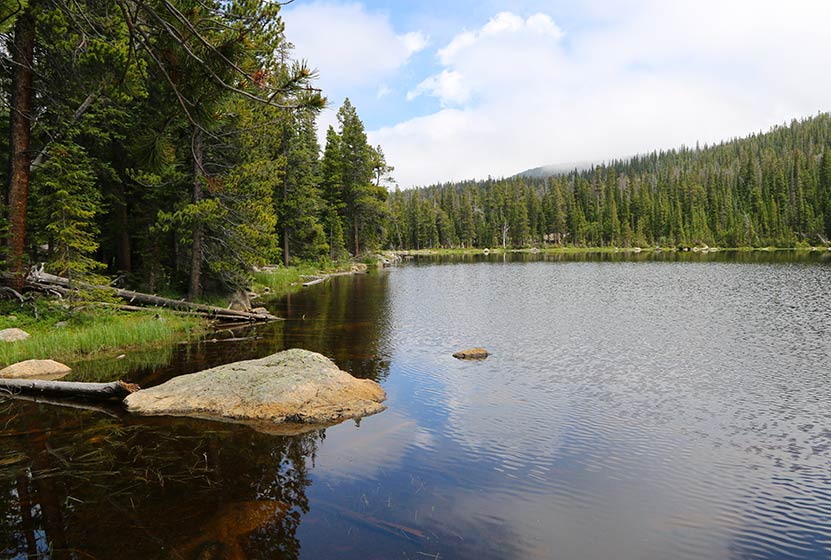
Finch Lake is a 4.5 mile hike through pines, aspen glades, and wildflower laden meadows to a sub-alpine lake where the forest surrounds its shores. The Finch Lake trail is a great choice for those who prefer solitude as it's one of the lesser traveled trails in the Wild Basin region of RMNP. Explore the full Finch Lake hike profile below for trail map, driving directions, and more tips and details to help you enjoy this adventure in Rocky Mountain National Park.
Note: Rocky Mountain National Park now requires timed entry permits from May 27th through October 10th. See the RMNP permits page for more information.
Trail Snapshot: Finch Lake in Rocky Mountain National Park
| Hike Distance | 9 miles Round Trip |
|---|---|
| Difficulty | Moderate |
| Duration | Approx 5-6 hr Round Trip |
| Trail Type | Out and Back |
| Starting Elevation | 8470' |
| Elevation Gain | Approx. +1442' |
| Seasons | Spring through Fall |
| Dogs | Prohibited in RMNP |
| Hike Trail Map | Click for a Map of Finch Lake RMNP |
| Denver Drive Time | 1 hr 30 min |
| Driving Directions to Finch Lake Trailhead | Click for Google Map |
| Town Nearest Hike | Allenspark, Colorado |
| Beauty | Waterfall, mountain views, meadows, aspen, river, wildlife: blue dragonfly, jackrabbit, mallard, Abert’s squirrel, elk, deer, moose, bear; wildflowers |
| Activities | Picnicking, hiking trails, snowshoeing, horseback riding, backcountry camping (with a permit), photography |
| Fee | Park Pass Required |
Parking & Trailhead Information for Finch Lake
The Finch Lake Trailhead is located approximately 1/5th of a mile east of the larger Wild Basin Trailhead near Allenspark, Colorado. Because there is very limited parking at the Finch Lake Trailhead, most hikers will need to park at the Wild Basin Trailhead and add the 1000' feet of trail between the Wild Basin Trailhead and the Finch Lake Trailhead to their journey. There is an alternative approach via the Allenspark Trailhead. However, the route described in this trail profile will be from the Finch Lake Trailhead nearest to the Wild Basin Trailhead.
- Map and Driving Directions to the Finch Lake Trailhead
- Map and Driving Directions to the Wild Basin Trailhead
The Hike: Finch Lake Trail in RMNP
The hike up to the Lake is a steady climb through a forest of pine, aspen, spruce, and meadows laden with wildflowers. It begins with a set of switchbacks then follows the contours of a moraine. After gaining the ridge of the moraine, the trail begins a gentle descent through one of Rocky Mountain National Park's most stunning displays of wildflowers. Near the bottom of the moraine, just above Fox Creek, the trail will come to its first junction. The the trail to the right/west leads towards both the lake (the left/east trail leads to the Allenspark Trailhead). Climbing higher, the trail will pass an overlook with views of the distant mountain peaks and the greater Wild Basin area.
The next trail junction--at approx. 2.5 miles--has been named "Confusion Junction" because of its power to confound hikers. Pause and study the trail signage in order to choose the correct trail. The correct way is the trail labeled "Pear Lake" and/or "Finch Lake."
After approximately 1/4 mile, the trail works its way through a burn area from a 1978 fire, now in full recovery mode and blanketed with summer wildflowers. Continuing to work uphill, the trail makes several stream crossings before a descent to the lake, which begins at 3.8 miles. Then, at approximately 4.25 miles, the trail makes a hard right-turn. This part of the trail is often obscured by snow as late as as midsummer and early as the first signs of autumn.
At the Lake the trail wraps around the eastern edge, then the northern shore of the lake. During midsummer, swarms of bright blue dragonflies dance along its waters. The Finch Lake backcountry camping sites are located on the north and northwestern side. These backcountry camping sites can be reserved through the RMNP Backcountry Offices.
Finch Lake is not a good fishing destination. However, Pear Lake, just 2 miles further up the trail, is a much better destination for anglers and offers spectacular views of the rugged peaks surrounding it.
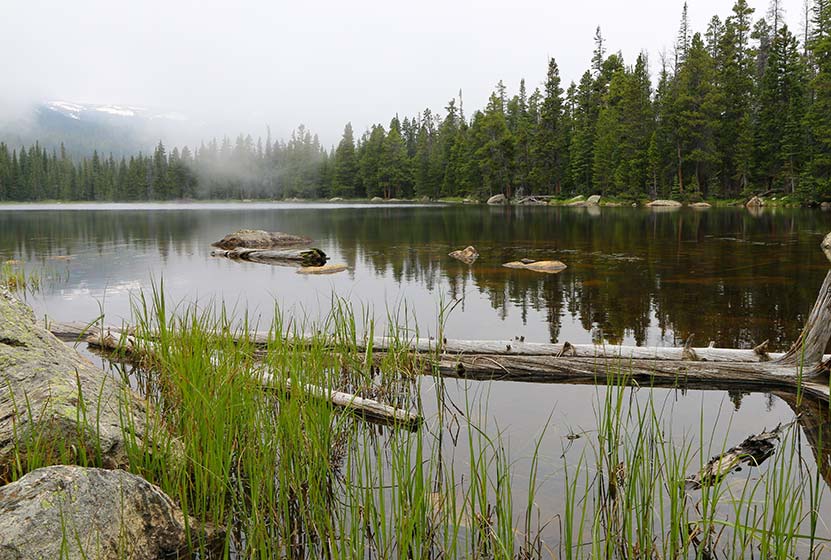
Finch Lake - Another View
Tips & Resources for Hiking to Finch Lake in RMNP
- Prepare: It's a long and demanding hike, so bring lots of water and high-energy food.
- Packing List: Always pack the 10 Essentials. Download our Hiking Guide to get list and dayhiking packing checklist.
- Get there early: Parking lot might get full even early in the morning. Hikers should expect to have to park at the Wild Basin Trailhead and add approximately 1/2 mile to their round trip hike (1000' one-way to the Finch Lake Trailhead).
- You’re in Bear Country: Black Bears live in the Wild Basin area and are active on the months of April through November. Be aware, dispose of your food responsibly, and don’t food or anything else with a strong scent in your vehicle.
- Trail Map for Wild Basin Area: Trail Map Link
- Colorado Road Conditions: Colorado Road Conditions
- Photo: We would like to express our gratitude to Shea Oliver for sharing such amazing photographs of this hike.
- After the Hike: Rock Creek Tavern & Pizzeria
Weather
Map & Driving Directions
Click for Driving Directions
Lawn Lake Hike in Rocky Mountain National Park
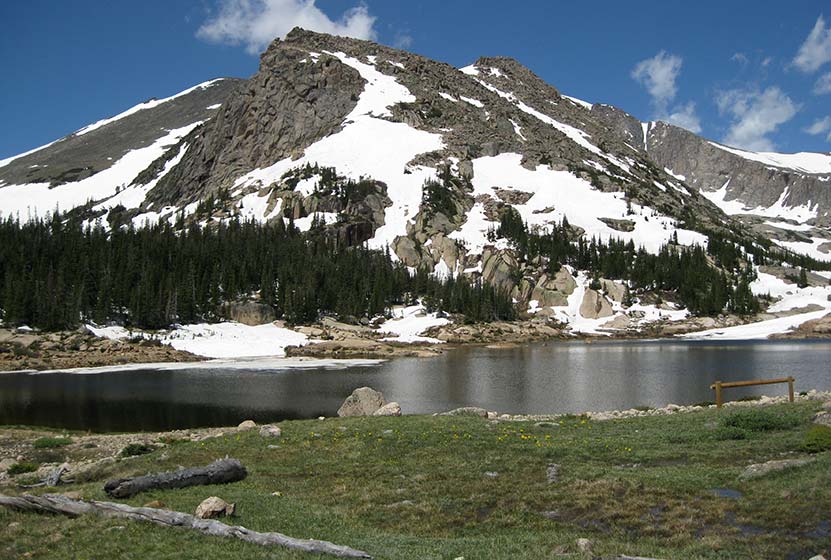
The hike to Lawn Lake in Rocky Mountain National Park follows the course of the Roaring River for 6.2 miles to a stunning high mountain lake with great fishing. This demanding hike takes adventurers into the heart of the Mummy Range, a lesser visited region of RMNP. Explore the full Lawn Lake hike profile below for trail map, driving directions, and more tips and details to help you enjoy this adventure in Rocky Mountain National Park.
Note: Rocky Mountain National Park now requires timed entry permits from May 27th through October 10th. See the RMNP permits page for more information.
Trail Snapshot: Lawn Lake in Rocky Mountain National Park
| Hike Distance | 12.4 miles Round Trip |
|---|---|
| Difficulty | Difficult |
| Duration | Approx 7-8 hr Round Trip |
| Trail Type | Out and Back |
| Starting Elevation | 8540' |
| Elevation Gain | Approx. +2249' |
| Seasons | Spring through Fall |
| Dogs | Prohibited in RMNP |
| Hike Trail Map | Click for a Map of Lawn Lake RMNP |
| Recommended Trail Map | We recommend the National Geographic Trails Illustrated Map - topographic with detailed information. |
| Denver Drive Time | 1 hr 40 min |
| Driving Directions to Lawn Lake Trailhead | Click for Google Map |
| Town Nearest Hike | Estes Park, Colorado |
| Beauty | Lake, waterfall, mountain views, aspen, ponderosa, meadows, river, wildlife: elk, Abert's squirrel; wildflowers |
| Activities | Picnicking, hiking trails, fishing, snowshoeing, horseback riding, backcountry camping (with a permit), photography |
| Fee | Park Pass Required |
Parking & Trailhead Information for Lawn Lake
The hike to Lawn Lake begins at the Lawn Lake Trailhead. Several other destinations in this lesser visited section of RMNP known as the Mummy Range, can be accessed from the Lawn Lake Trailhead, including Ypsilon Lake, Ypsilon Falls, Chipmunk Lake, and the Spectacle Lakes. The parking area is located on Old Fall River Road, just north of the intersection of Old Fall River Road and Highway 34.
The Hike: Lawn Lake Trail in RMNP
The hike begins on a 1.4 mile stretch of the Lawn Lake trail before the intersection with the Ypsilon Lake Trail. This initial segment climbs a series of switchbacks. While it may be tempting to cut the switchbacks, they are there for a couple important purposes: to control erosion and to preserve your energy. Because this area of the park has been severely damaged by floods, it’s all the more important to stay the trail.
At approximately 1.4 miles, the Lawn Lake Trail meets with the Ypsilon Lake Trail. See the full trail profiles for Ypsilon Lake and Ypsilon Falls for exploring these destinations. At the junction, the way to the Lake passes by this junction, continuing straight/North on the Lawn Lake Trail
Here, the trail comes quite close to the gorge that overlooks Roariing River. There are areas of unstable terrain and hikers should take caution and stay away from the precarious edges of the gorge.
The trail begins a demanding climb up a series of switchbacks then returns to follow river. Three backcountry camping sites are located in this stretch, just after the confluence of Roaring River and Ypsilon Creek: Ypsilon Creek, Cutbank, and Golden Banner. At 5.6 miles, the Lawn Lake Trail meets up with the Black Canyon Trail. Here, the way to the Lake is left/North, and should be clearly marked by a sign at the junction. The Lake is about 1/2 a mile further up the trail.
There is another backcountry camping site at the Lake. This site and the others along the Lawn Lake trail can be reserved through the RMNP Backcountry Offices. Greenback Cutthroat trout are plenty in the Lake, so this makes for a great fly fishing destination in Rocky Mountain National Park. A fishing license is required and State and Park fishing regulations apply.
Tips & Resources for Hiking to Lawn Lake in RMNP
- Explore More: Crystal Lake is just about 1.5 mi further. You may opt to continue if you have energy to spare.
- Packing List: Always pack the 10 Essentials. Download our Hiking Guide to get list and dayhiking packing checklist.
- Get there early: Parking may be somewhat limited as with many hikes in RMNP area and can get full even early in the morning.
- Recommended Trail Map: We recommend the National Geographic Trails Illustrated Map which indicates the location of the Upper Chipmunk Backcountry Camping Site, and provides topo information.
- Colorado Road Conditions: Colorado Road Conditions
- Photo: We would like to express our gratitude to Chad Bowman for sharing such an amazing photograph of this hike to Lawn Lake in RMNP.
- After the Hike: Mountain Home Café
Weather
Map & Driving Directions
Click for Driving Directions
Lyric Falls Hike in Rocky Mountain National Park
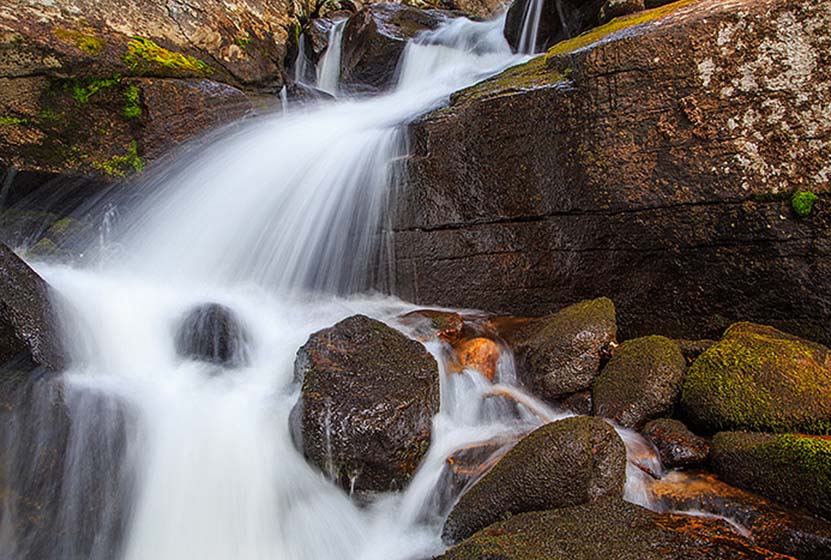
Lyric Falls is a beautiful stair-step waterfall that spills over the moss-covered granite slabs of Hunters Creek in Rocky Mountain National Park. A lesser-known waterfall, Lyric Falls requires a 3/4 mile segment on the unmaintained social trail that winds along Hunters Creek. Locating the falls may be a bit challenging and land navigation skills are needed for this hike in the Wild Basin area of RMNP. Explore the full Lyric Falls hike profile below for trail map, driving directions, and more tips and details to help you enjoy this adventure in Rocky Mountain National Park.
Note: Rocky Mountain National Park now requires timed entry permits from May 27th through October 10th. See the RMNP permits page for more information.
| Hike Distance | Approx 8 miles Round Trip |
|---|---|
| Difficulty | Moderate |
| Duration | 6-8 hr Round Trip |
| Trail Type | Out and Back |
| Starting Elevation | 8430' |
| Elevation Gain | Approx. +1730' |
| Seasons | Spring through Fall |
| Dogs | Prohibited in RMNP |
| Hike Trail Map | Click for a Map of Wild Basin Area |
| Trails Illustrated Map | Recommended Topo Map Noting Location of Lyric Falls |
| Denver Drive Time | 1 hr 30 min |
| Driving Directions to Sandbeach Lake Trailhead | Click for Google Map |
| Town Nearest Hike | Allenspark, Colorado |
| Beauty | Mountain views, aspen, ponderosa, limber pine, creek, wildlife: Abert’s squirrel, elk, deer, moose, bear; wildflowers |
| Activities | Picnicking, hiking trails, winter snowshoeing, horseback riding, backcountry camping (with a permit), photography |
| Fee | Park Pass Required |
Parking & Trailhead Information for Lyric Falls
The Sandbeach Lake Trailhead is located off of County Road 84 near, just about 1/2 mile west from its junction with Highway 7. See the driving directions link above for the detailed route. The trailhead is across the street from the Wild Basin Lodge and Event Center. The trailhead has toilet facilities and parking capacity of about 25 cars (includes gravel side-lot).
The Hike: Lyric Falls Trail in RMNP
The first segment of the hike to Lyric Falls follows the Sandbeach Lake Trail for approximately 3.2 miles to the footbridge crossing Hunter's Creek. An indistinct social trail is located near the bridge on the east side of Hunter's creek. This second trail segment is 3/4 of a mile is unmaintained, which means that hikers should have a sufficient level of land navigation skills (map reading and proficiency with a compass/gps unit) to negotiate the terrain to Lyric Falls.
This .75 mile section follows the course of Hunter's Creek Northwest and uphill to the location of Lyric Falls. There is no marker for Lyric Falls, but it can be located on the National Geographic Trails Illustrated Map of Rocky Mountain National Park. Hikers will likely hear several smaller cascades along the way. In the same way, the cascades of Lyric Falls will be heard before seen, and the sounds of its splash and spray will be the best way to locate the falls.
A meadow bright with wildflowers can be found just bit further up Hunter's Creek beyond Lyric Falls.
Campsites Along the Lyric Falls Trail
Stay overnight and explore the larger Hunter's Creek Drainage. There are several Backcountry Camping sites along the Sandbeach Lake Trail: Hole-in-the-Wall, Campers Creek, Beaver Mill, and Sandbeach Lake. These backcountry camping sites can be reserved through the RMNP Backcountry Offices. Staying overnight, hikers can then explore Lyric Falls, Sandbeach Lake, and this lesser hiked area of the Wild Basin in Rocky Mountain National Park.
Tips & Resources for Hiking to Lyric Falls in RMNP
- Packing List: Always pack the 10 Essentials. Download our Hiking Guide to get list and dayhiking packing checklist.
- Recommended Trail Map: We recommend the National Geographic Trails Illustrated Map which indicates the location of the Backcountry Camping Sites, and provides topo information, too.
- Get there early: Parking is limited. Arrive early to secure a parking spot at the trailhead.
- You’re in Bear Country: Black Bears live in the Wild Basin area and are active on the months of April through November. Be aware, dispose of your food responsibly, and don’t food or anything else with a strong scent in your vehicle.
- Colorado Road Conditions: Colorado Road Conditions
- Photo: We would like to express our gratitude to Thomas Mangan for sharing such great photos of this hike to Lyric Falls in RMNP. Tom leads photography tours in Rocky Mountain National Park. Check out his site thomasmagan.com for details.
- After the Hike: Meadow Mountain Cafe in Allenspark, Colorado
Weather
Map & Driving Directions
Click for Driving Directions
Bluebird Lake in Rocky Mountain National Park
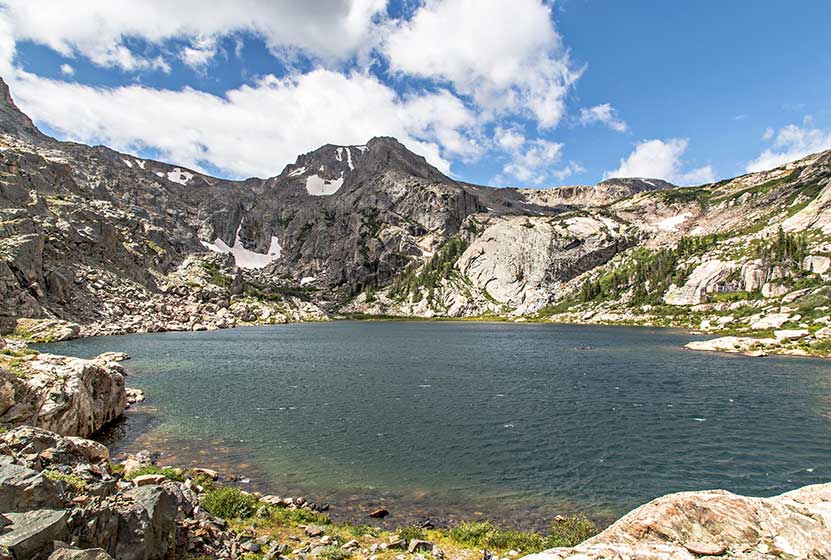
Bluebird Lake is a 6 mile hike to an alpine lake surrounded by craggy peaks in the Wild Basin of Rocky Mountain National Park. Add an additional 1/2 mile spur trail to reach great trout fishing at Ouzel Lake. Hikers will enjoy panoramic views of the Wild Basin and the sites and sounds of several cascade waterfalls along the way. Wildflowers, waterfalls, and lakes await, so explore the full Bluebird Lake hike profile below for trail map, driving directions, and more tips and details to help you enjoy this adventure in Rocky Mountain National Park.
Note: Rocky Mountain National Park now requires timed entry permits from May 27th through October 10th. See the RMNP permits page for more information.
Trail Snapshot: Bluebird Lake in Rocky Mountain National Park
| Hike Distance | 12 miles Round Trip |
|---|---|
| Difficulty | Difficult |
| Duration | Approx 7+ hr Round Trip |
| Trail Type | Out and Back |
| Starting Elevation | 8566' |
| Elevation Gain | Approx. +2478' |
| Seasons | Spring through Fall, Winter Snowshoeing |
| Dogs | Prohibited in RMNP |
| Hike Trail Map | Click for a Trail Map |
| Denver Drive Time | 1 hr 30 min |
| Driving Directions to Wild Basin Trailhead | Click for Google Map |
| Driving Directions to Winter Recreation Parking for Wild Basin Hikes | Click for Google Map |
| Town Nearest Hike | Allenspark, Colorado |
| Beauty | Lake, alpine tundra, waterfall, mountain views, meadows, river, wildlife: Abert's squirrel, elk, deer, moose, marmot, bear; wildflowers |
| Activities | Picnicking, hiking trails, snowshoeing, horseback riding, backcountry camping (with a permit), photography |
| Fee | Park Pass Required |
Parking & Trailhead Information for Bluebird Lake
The southeast corner of Rocky Mountain National Park boasts one of the loveliest portions in the park known as the Wild Basin. The Wild Basin Trailhead is located just 15 minutes outside of Allenspark, Colorado along Highway 115. There is a ranger station at at the Wild Basin Trailhead with toilets and drinking water available.
In the winter (October-May), Hwy 115 may not be plowed to the trailhead, and hikers will need to park their vehicles at a winter parking lot for Wild Basin hikes. Be aware that hikes from the winter parking lot add on another 3 miles of hiking (one-way). There are other small parking areas, like the Finch Lake Trailhead, that may be accessible and allow hikers to park closer to the Wild Basin Trailhead. It's important to know that Hwy 115, though titled a "highway", is a maintained dirt road, which means that it can be used by 2WD vehicles. However, after heavy rains and other severe weather, its quality may degrade until it is repaired. 4WD may be needed when snow is on the ground.
The Hike: Bluebird Lake Trail in RMNP
With an elevation gain of over 2400' over 6 miles of trail, the hike up to Bluebird Lake in RMNP is demanding, but not without its rewards. The hike to Bluebird Lake begins at the Wild Basin Trailhead, then winds through the central region of the Wild Basin, passing three cascade waterfalls along the way, and a fourth unnamed waterfall in the meadows above Ouzel Lake.
The first waterfall on this hike is Copeland Falls, found 0.4 mile into the hike on this first, easy segment of trail. For details on accessing both the lower and upper leaps of Copeland Falls, check out our full trail profile for Copeland Falls.
The trail continues west/southwest following North Saint Vrain Creek until it reaches the first important trail junction. The trail to the right leads past a series of backcountry campsites. These are reservable through the Rocky Mountain National Park Wilderness offices and make for a great place to stay for longer adventures into the Wild Basin area. The left-hand trail is the correct way towards the Bluebird Lake trail system and Bluebird Lake.
Having taken the left-hand trail, the path soon crosses North St. Vrain Creek on a log bridge, one that recently was rebuilt to replace the bridge that washed out during the 2013 floods. An unnamed cascade can be viewed from the bridge area. Soon after the bridge, the trail meets with a second trail junction at Calypso Cascades. Taking the right-hand trail, the cascades (named after the purple orchids that grow along the creek) come into view. The path crosses a second bridge at 1.8 miles and begins a challenging climb as the trail weaves through a set of switchbacks up to Ouzel Falls at 2.7 miles.
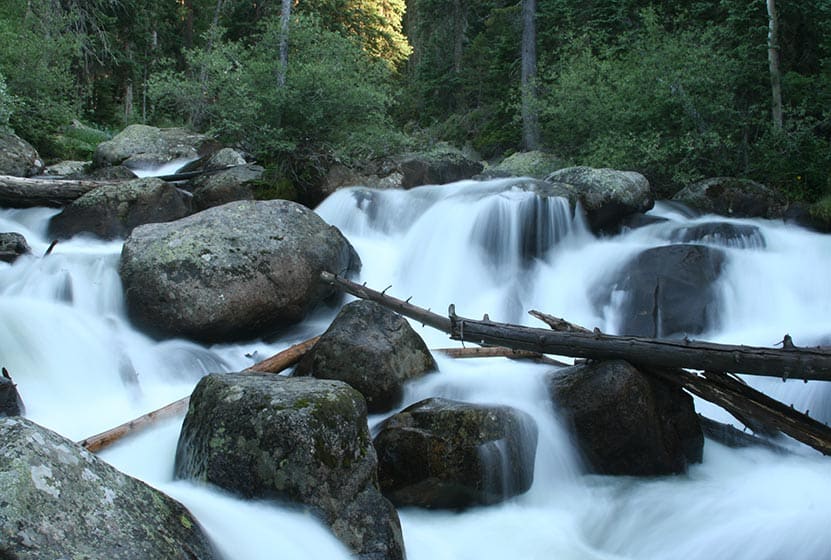
At 0.4 mile beyond Ouzel Falls, the trail comes to a junction with the Bluebird Lake trail; this is 3.1 miles into the hike, approximately half-way to Bluebird Lake. This new trail begins a steady climb up a ridgeline, through an area burned out by a fire that started from a lightning strike back in 1978. Yet the almost 40 years have brought some change to the landscape. Wildflowers decorate the hillsides, and new trees have come back and begun to establish themselves on the mountainsides.
At 4.5 miles, there is a marked trail spur that leads to Ouzel lake. This 1/2 mile spur takes hikers to some of the best fishing in Rocky Mountain National Park! Of course, a Colorado State fishing license is required. A hike down this spur to Ouzel, will add another 1 to this hike to Bluebird, and it may be a good idea to visit Ouzel on the way back, after judging the conditions of the skies. From the Ouzel Spur junction, Bluebird Lake is just 1.6 miles further, but 1000' in elevation higher, making this part of the hike the most challenging. An unnamed waterfall can be viewed just in the meadows past Chickadee Pond (the small pond just past the trail Ouzel Lake trail spur).
Crossing boulder fields and snow, the trail can be difficult to discern at times, and hikers can keep track of the trail by keeping a look out for cairns (stacked rocks marking the trail). Near the sign for the Upper Ouzel Creek campsite, the trail will cross Ouzel Creek and begin a very steep climb up to Bluebird Lake. Bluebird Lake does not have fish, but it makes up for it with the views, particularly the rugged face of Ouzel Peak in the southwest.
Tips & Resources for Hiking to Bluebird Lake in RMNP
- Too Long of A Hike?: Because this is a 12 mile round-trip hike--13 miles if you add in Ouzel Lake--it may be best to make this hike a part of a larger overnight adventure. Reserve one of the two backcountry camping sites along the Bluebird Trail to spend some time fishing Ouzel Lake and exploring the other destinations along the trail. Contact the RMNP Wilderness Offices to reserve a site.
- Summer Thunderstorms: If you see clouds with dark undersides building in the west, this means that thunderstorms are likely--a typical occurrence on most summer days. Begin hikes early to avoid storms and consider turning back if weather looks threatening.
- Get there early: Parking may be somewhat limited as with many hikes in RMNP area and can get full even early in the morning.
- You're in Bear Country: Black Bears live in the Wild Basin area and are active on the months of April through November. Be aware, and dispose of your food responsibly.
- Trail Map for Wild Basin Area: Trail Map Link
- Packing List: Always pack the 10 Essentials. Download our Hiking Guide to get list and dayhiking packing checklist.
- Colorado Road Conditions: Colorado Road Conditions
- Photo: We would like to express our gratitude to Erik Wolf for sharing such an amazing photograph of this hike to Bluebird Lake in RMNP.
- After the Hike: Meadow Mountain Cafe
Weather
Map & Driving Directions
Click for Driving Directions

Ouzel Lake Hike in Rocky Mountain National Park
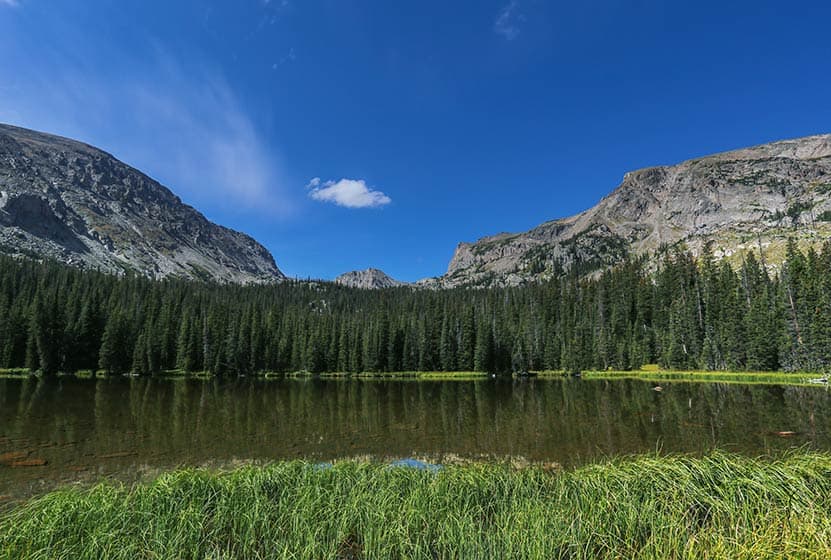
Ouzel Lake is nestled in an expansive valley in the Wild Basin, and is one of the better fishing destinations in Rocky Mountain National Park. It's a moderate, 4.9 mile, creekside hike that passes several beautiful cascade waterfalls, including one of our favorites, Ouzel Falls. Combine the hike to Ouzel Lake with an overnight, and a journey to the shores Bluebird Lake. Explore the full Ouzel Lake hike profile below for trail map, driving directions, and more tips and details to help you enjoy this adventure in Rocky Mountain National Park.
Note: Rocky Mountain National Park now requires timed entry permits from May 27th through October 10th. See the RMNP permits page for more information.
Trail Snapshot: Ouzel Lake in Rocky Mountain National Park
| Hike Distance | 9.8 miles Round Trip |
|---|---|
| Difficulty | Moderate |
| Duration | Approx 5-7 hr Round Trip |
| Trail Type | Out and Back |
| Starting Elevation | 8566' |
| Elevation Gain | Approx +1510' |
| Seasons | Spring through Fall |
| Dogs | Prohibited in RMNP |
| Hike Trail Map | Click for a Map of Ouzel Lake RMNP |
| Denver Drive Time | 1 hr 30 min |
| Driving Directions to Wild Basin Trailhead | Click for Google Map |
| Driving Directions to Winter Recreation Parking for Wild Basin Hikes | Click for Google Map |
| Town Nearest Hike | Allenspark, Colorado |
| Beauty | Lake, alpine tundra, waterfall, mountain views, meadows, river, wildlife: Abert's squirrel, elk, deer, moose, bear; wildflowers |
| Activities | Fly fishing, picnicking, hiking trails, snowshoeing, horseback riding, backcountry camping (with a permit), photography |
| Fee | Park Pass Required |
Parking & Trailhead Information for Ouzel Lake
The southeast corner of Rocky Mountain National Park boasts one of the loveliest portions in the park known as the Wild Basin. The Wild Basin Trailhead is located just 15 minutes outside of Allenspark, Colorado along Highway 115. There is a ranger station at at the Wild Basin Trailhead with toilets and drinking water available.
In the winter (October-May), Hwy 115 may not be plowed to the trailhead, and hikers will need to park their vehicles at a winter parking lot for Wild Basin hikes. Be aware that hikes from the winter parking lot add on another 3 miles of hiking (one-way). There are other small parking areas, like the Finch Lake Trailhead, that may be accessible and allow hikers to park closer to the Wild Basin Trailhead. It's important to know that Hwy 115, though titled a "highway", is a maintained dirt road, which means that it can be used by 2WD vehicles. However, after heavy rains and other severe weather, its quality may degrade until it is repaired. 4WD may be needed when snow is on the ground.
The Hike: Ouzel Lake Trail in RMNP
It's 4.9 miles one-way to Ouzel Lake. The trail begins at the Wild Basin Trailhead, and takes hikers through the central area of the Wild Basin, past three cascade waterfalls: Copeland Falls, Calypso Cascades, and Ouzel Falls.
The first waterfall, Copeland Falls, is just 0.4 mile into the hike on this first, easy segment of trail. For details on accessing both the lower and upper leaps of Copeland Falls, check out our full trail profile for Copeland Falls.
The path follows North Saint Vrain Creek until it encounters a first trail junction. The trail to the right leads past a series of backcountry campsites. These are reservable through the Rocky Mountain National Park Wilderness offices and make for a great place to stay for longer adventures into the Wild Basin area. The left-hand trail is the correct way towards the Bluebird Lake trail system and Ouzel Lake.
Having taken the left-hand trail, hikers cross a large log bridge spanning North St. Vrain Creek. Pause when you hear the sounds of an unnamed cascade that can be viewed from the bridge area. Soon after the bridge, the trail meets with a second trail junction at Calypso Cascades. Taking the right-hand trail, the cascades (named after the purple orchids that grow along the creek) come into view. The path crosses a second bridge at 1.8 miles, then things begin to get more challenging, as the trail weaves through a set of switchbacks to Ouzel Falls at 2.7 miles.
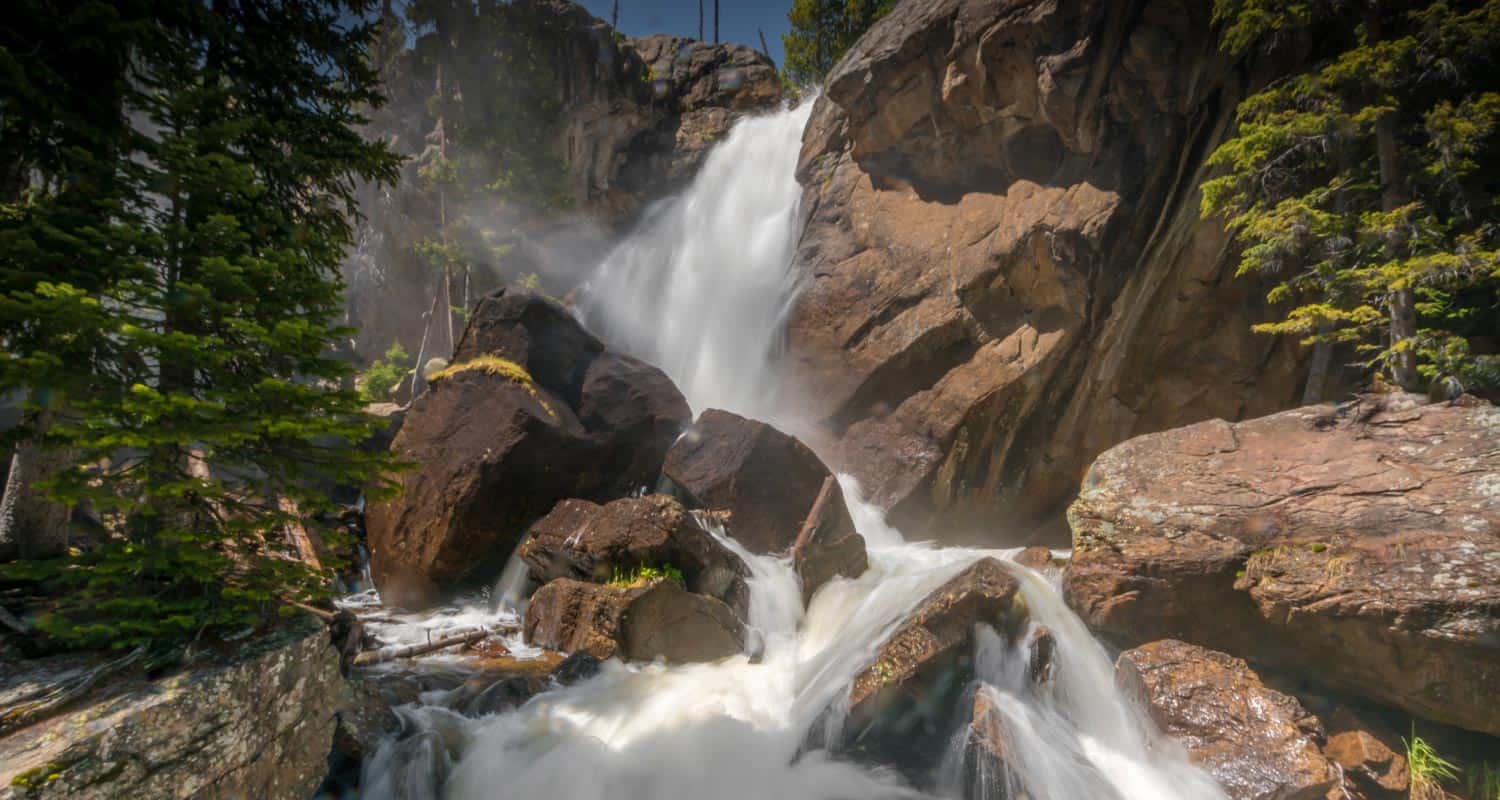
Ouzel Falls on a Wet Spring Day - Courtesy of Chris Heald
After about 0.4 mile past Ouzel Falls, the trail comes to a junction with the Bluebird Lake trail, 3.1 miles into the hike. The way to Ouzel Lake takes the Bluebird Trail (left). This final 1.8 segment of the hike to Ouzel Lake gains a ridgeline and becomes more demanding. It's a desolate segment of trail, charred by a fire in 1978. However, wildflowers make their way up through the barren landscape, and the surrounding mountain peaks come into full view due to the few trees left by the burn.
At 4.5 miles, there is a marked trail spur that leads to Ouzel Lake, bending its way around a small pond to Ouzel's northwestern shore. At the lake, you'll find more trees and a lot of marshland--and marsh = mosquitos, so be sure to bring repellant. If you are looking to try some deet-free repellant, we have had some great luck with a lemon-ecualyptus repellant made by repel. The fishing up at Ouzel Lake is great! Of course, a Colorado State fishing license is required.
Tips & Resources for Hiking to Ouzel Lake in RMNP
- Camp + Hike + Fish: Reserve one of the two backcountry camping sites along the Bluebird Trail to spend some time fishing Ouzel Lake and exploring the other destinations along the trail: Bluebird Lake, a waterfall between them, Lark Pond, and Pipit Lake. Contact the RMNP Wilderness Offices to reserve a site.
- Summer Thunderstorms: If you see clouds with dark undersides building in the west, this means that thunderstorms are likely--a typical occurrence on most summer days. Begin hikes early to avoid storms and consider turning back if weather looks threatening.
- Get there early: Parking may be somewhat limited as with many hikes in RMNP area and can get full even early in the morning.
- You're in Bear Country: Black Bears live in the Wild Basin area and are active on the months of April through November. Be aware, and dispose of your food responsibly.
- Trail Map for Wild Basin Area: Trail Map Link
- Packing List: Always pack the 10 Essentials. Download our Hiking Guide to get list and dayhiking packing checklist.
- Food Storage: There are food storage lockers available at the Wild Basin, Finch Lake, and Sandbeach Lake Trailheads. These are required for visitors staying overnight. Backcountry campers are required to use bear resistant food containers.
- Colorado Road Conditions: Colorado Road Conditions
- Photo: We would like to express our gratitude to Ed Ogle for sharing such an amazing photograph of this hike to Ouzel Lake in RMNP.
- After the Hike: Meadow Mountain Cafe
Weather
Map & Driving Directions
Click for Driving Directions
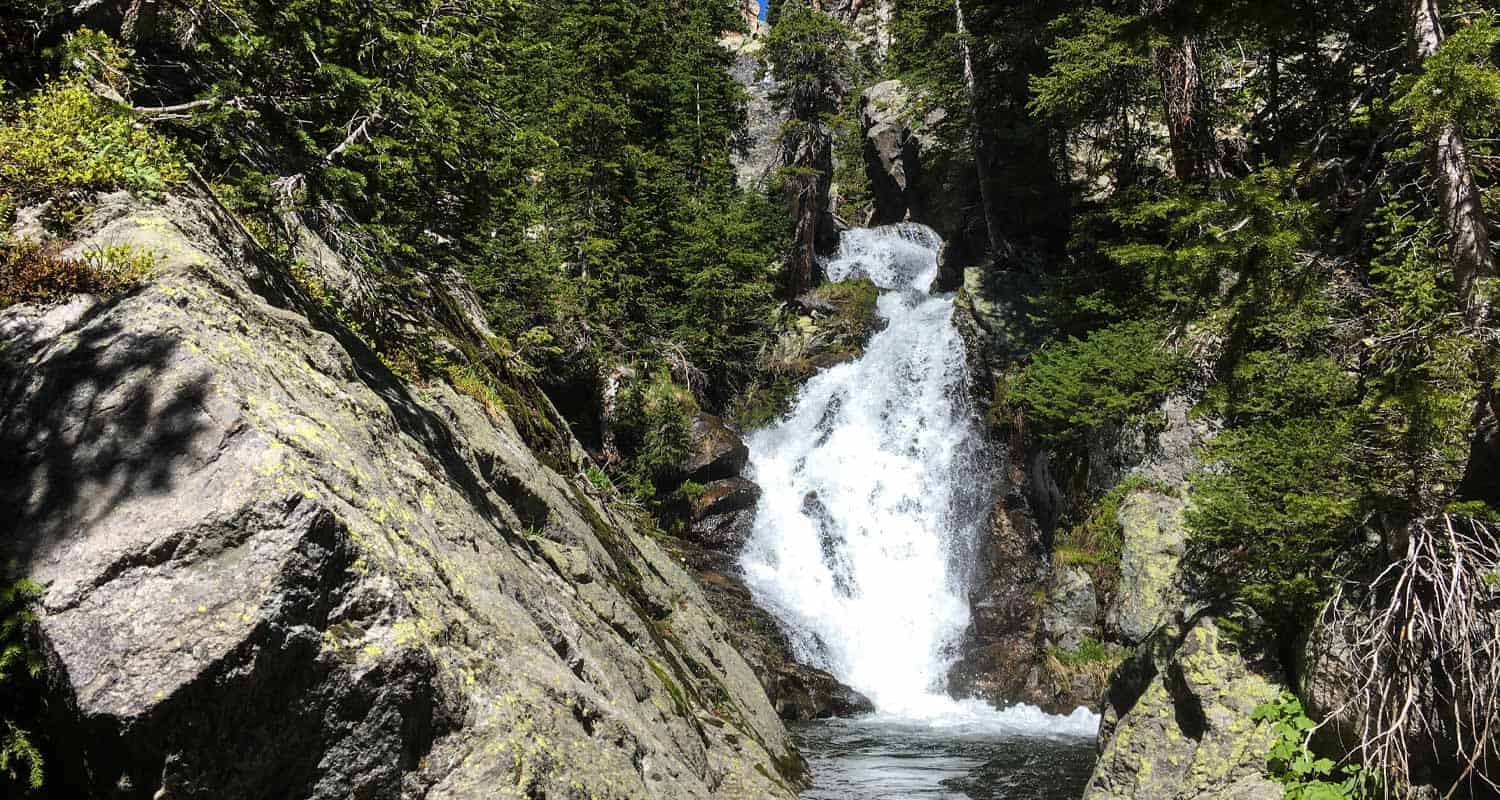
Ypsilon Falls in Rocky Mountain National Park
Ypsilon Falls is a tiered waterfall hidden along the northern shore of Ypsilon Lake in Rocky Mountain National Park. The 4.5 mile hike to this secluded waterfall follows the Ypsilon Lake trail, a demanding trek through the thick woods of the Mummy Range. Explore the full Ypsilon Falls hike profile below for trail map, driving directions, and more tips and details to help you enjoy this adventure in Rocky Mountain National Park.
Note: Rocky Mountain National Park now requires timed entry permits from May 27th through October 10th. See the RMNP permits page for more information.
Trail Snapshot: Ypsilon Falls in Rocky Mountain National Park
| Hike Distance | 9 miles Round Trip |
|---|---|
| Difficulty | Difficult |
| Duration | Approx 5-6 hr Round Trip |
| Trail Type | Out and Back |
| Starting Elevation | 8540′ |
| Elevation Gain | Approx +2180′ |
| Seasons | Spring through Fall |
| Dogs | Prohibited in RMNP |
| Hike Trail Map | Click for a Map of Ypsilon Falls RMNP |
| Recommended Trail Map | We recommend the National Geographic Trails Illustrated Map - topographic with detailed information. |
| Denver Drive Time | 1 hr 40 min |
| Driving Directions to Lawn Lake Trailhead | Click for Google Map |
| Town Nearest Hike | Estes Park, Colorado |
| Beauty | Lake, waterfall, mountain views, aspen, ponderosa, meadows, river, wildlife: elk, Abert's squirrel; wildflowers |
| Activities | Picnicking, hiking trails, fishing, snowshoeing, horseback riding, backcountry camping (with a permit), photography |
| Fee | Park Pass Required |
Parking & Trailhead Information for Ypsilon Falls
The hike to Ypsilon Lake begins at the Lawn Lake Trailhead. Several other destinations in this lesser visited section of RMNP known as the Mummy Range, can be accessed from the Lawn Lake Trailhead, including Ypsilon Falls, Lawn Lake, Chipmunk Lake, and the Spectacle Lakes. The parking area is located on Old Fall River Road, just north of the intersection of Old Fall River Road and Highway 34.
The Hike: Ypsilon Falls Trail in RMNP
The hike begins on a 1.4 mile stretch of the Lawn Lake trail before the intersection with the Ypsilon Lake Trail. This initial segment climbs a series of switchbacks. While it may be tempting to cut the switchbacks, they are there for a couple important purposes: to control erosion, and to preserve your energy. Because this area of RMNP has been severely damaged by floods, it's all the more important to stay the trail. Because of the floods, there are also areas of unstable terrain.
At 1.4 mile, the Ypsilon Lake trail junction will emerge on the left-hand side of the Lawn Lake trail. Here, the trail crosses the Roaring River--but the bridge has been washed out by a flood in the Spring of 2013. At the time of writing this trail profile (June 2016) the bridge has not been replace. However, the river can be crossed at low water. It's easy to underestimate the hydraulic force of a river, so exercise care in crossing. If you're planning to hike to Ypsilon Lake, it's important to have a back plan, just in case you run into high water levels at the ford. Typically, the water levels are low, but both snowmelt and heavy rains can change levels quickly.
Approximately 0.5 mile after crossing the Roaring River (@ 2 miles), the trail begins a sustained climb along the ridge of a moraine. This longest segment of the hike leads through thick timber, then crests at 3.8 miles before descending to Chipmunk Lake @ 4.0 miles. The mountain peak reflections in Chipmunk Lake make this worth stopping for a photo.
There is a backcountry camping area with two individual sites just past Chimpmunk Lake at 10,640'. Camping permits can be obtained through the RMNP Wilderness offices. The trail from Chipmunk Lake to Ypsilon lake is just 0.5 mile, arriving at Ypsilon's western shore. Hikers who pause to listen may hear the sounds of Ypsilon Falls. This segmented and tiered cascade can be accessed by crossing a small footbridge, then hiking toward the sounds of the falls along Ypsilon's northwestern shore.
The return hike follows the same route back to the Lawn Lake trailhead, making this a 9-mile, round-trip journey.
Tips & Resources for Hiking to Ypsilon Falls in RMNP
- Packing List: Always pack the 10 Essentials. Download our Hiking Guide to get list and dayhiking packing checklist.
- Bridge Out: Due to the damage caused by a flood in September 2013, the bridge over Roaring River is missing. Cross only during low water, and see the RMNP flood closures page for updates.
- Get there early: Parking may be somewhat limited as with many hikes in RMNP area and can get full even early in the morning.
- Recommended Trail Map: We recommend the National Geographic Trails Illustrated Map which indicates the location of the Upper Chipmunk Backcountry Camping Site, and provides topo information.
- Colorado Road Conditions: Colorado Road Conditions
- Photo: We would like to express our gratitude to Aaron Cooper for sharing such an amazing photograph of this hike to Ypsilon Falls in RMNP.
- After the Hike: Mountain Home Café
Weather
Map & Driving Directions
Click for Driving Directions
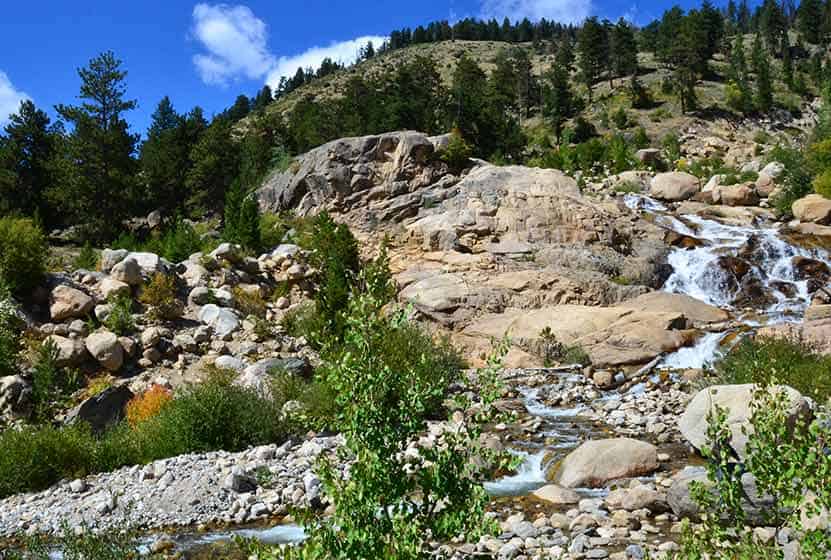
Horseshoe Falls in Rocky Mountain National Park
Horseshoe Falls in Rocky Mountain National Park is a favorite family hike near Estes Park, Colorado. It's a short and easy hike from the Alluvial Fan Trailhead, but the falls can also be viewed from the roadside. It's an extensive cascade waterfall, named for the way it bends its course through the rocky hillside. Explore the full Horseshoe Falls hike profile below for trail map, driving directions, and more tips and details to help you enjoy this adventure in Rocky Mountain National Park.
Note: Rocky Mountain National Park now requires timed entry permits from May 27th through October 10th. See the RMNP permits page for more information.
Trail Snapshot: Horseshoe Falls in Rocky Mountain National Park
| Hike Distance | 0.4 mile Round Trip |
|---|---|
| Difficulty | Easy |
| Duration | Approx less than 1 hr Round Trip |
| Trail Type | Out and Back |
| Starting Elevation | 8550' |
| Elevation Gain | Approx. +130' |
| Seasons | Spring through Fall, Winter Snowshoeing |
| Dogs | Prohibited in RMNP |
| Hike Trail Map | Click for a Map of Horseshoe Falls RMNP |
| Denver Drive Time | 1 hr 40 min |
| Driving Directions to West Alluvial Fan Trailhead | Click for Google Map |
| Driving Directions to East Alluvial Fan Trailhead | Click for Google Map |
| Town Nearest Hike | Estes Park, Colorado |
| Beauty | Waterfall, mountain views, meadows, river, wildlife: elk, big horn sheep, Abert's squirrel, deer, moose, bear; wildflowers |
| Activities | Picnicking, hiking trails, snowshoeing, horseback riding, backcountry camping (with a permit), photography |
| Fee | Park Pass Required |
Parking & Trailhead Information for Horseshoe Falls
Horseshoe Falls can be accessed just outside Estes Park, Colorado by taking Fall River Road to Old Fall River Road. The East Alluvial Fan Trailhead is approximately 1/2 mile up Old Fall River Road, and the West Alluvial Fan Trailhead is just about 1/4 of a mile further. Because Horseshoe Falls is popular destination in RMNP, the parking fills up fast. There is an additional parking area just before reaching the East Alluvial Fan Trailhead, see this link for driving directions and map.
The Hike: Horseshoe Falls Trail in RMNP
This short hike to Horseshoe Falls got even shorter because of the 2013 flooding in the Estes Park and Rocky Mountain National Park area. As of this writing (6/30/2016) both the East and West Alluvial Fan Trailhead parking areas have reopened. However, the trails are still buried under rock and debris, and the bridge--which used to be a great viewing platform for Horseshoe Falls--has not been replaced. This doesn't mean a short hike up to the base of the falls is impossible, but it does require a some care in navigating the terrain. The official RMNP communications ask hikers first consult posted signs or speak with a park ranger before making the trek. As with all off-trail hiking along rivers, it's important to exercise caution near fast moving water and on the surrounding slippery surfaces of rocks and logs.
When the trail is repaired (assuming that it will use the same route), the Alluvial Fan Trail can be hiked from either of the two lots to the bridge viewing area, which is just under 1/4 mile one-way.
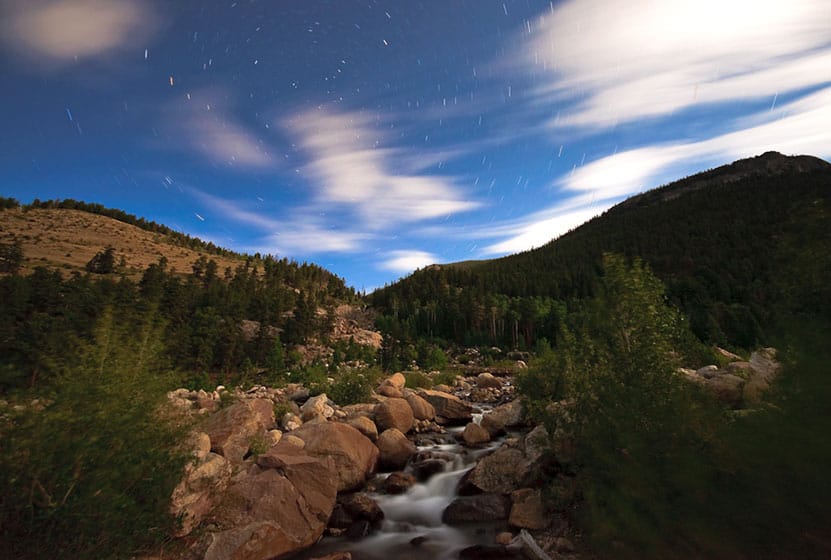
Horseshoe Falls and the larger Alluvial Fan area have an interesting history. Before the establishment of Rocky Mountain National Park, a twenty-six foot high dam was built to enlarge Lawn Lake, which is located about 6.5 miles north of Horseshoe Falls and a major source of the Roaring River. On a perfectly normal day in the Summer of 1982, an almost 100 foot stretch of the dam collapsed and sent a 30-foot high wall of water careening down the valley. At Horseshoe Park, much of the wash settled into what is now known as the 42 acre Alluvial Fan, comprised of sorted gravel, boulders--some over 400 tons--and streams of sand. Three people lost their lives in the flood, one camper, and two folks who had ventured out to capture photos of the event. The river surged all the way into the downtown of Estes Park, carrying away trees and cars, and breaking through another dam before being contained by Lake Estes.
Tips & Resources for Hiking to Horseshoe Falls in RMNP
- For Closure Updates: See the Rocky Mountain National Park Flood Impact and Closure page for updates on the conditions of this trail.
- TIP: The Alluvial Fan and larger Horseshoe Park area are popular spots for viewing Elk.
- Get there early: Parking may be somewhat limited as with many hikes in RMNP area and can get full even early in the morning.
- Trail Map for Fall River Area: Trail Map Link
- Packing List: Always pack the 10 Essentials. Download our Hiking Guide to get list and dayhiking packing checklist.
- Colorado Road Conditions: Colorado Road Conditions
- Photo: We would like to express our gratitude to Joan Morris Holzer for sharing such an amazing photograph of this hike to Horseshoe Falls in RMNP.
- After the Hike: Mountain Home Café
Weather
Map & Driving Directions
Click for Driving Directions
Falcon Falls in Rocky Mountain National Park
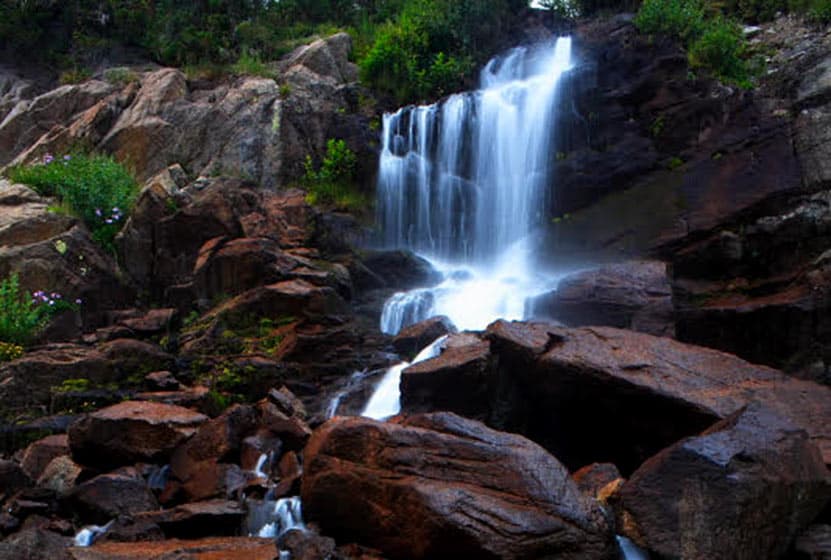
Falcon Falls is one of two waterfalls that spill from the heights above Thunder Lake in this remote part of the Wild Basin. It's a difficult and demanding 16 mile round-trip hike that requires some land navigation and backcountry travel skills. Explore the full Falcon Falls hike profile below for trail map, driving directions, and more tips and details to help you enjoy this adventure in Rocky Mountain National Park.
Note: Rocky Mountain National Park now requires timed entry permits from May 27th through October 10th. See the RMNP permits page for more information.
Trail Snapshot: Falcon Falls in Rocky Mountain National Park
| Hike Distance | 15.5 - 16.5 miles Round Trip |
|---|---|
| Difficulty | Difficult |
| Duration | 8-11 hr Round Trip |
| Trail Type | Out and Back |
| Starting Elevation | 8566' |
| Elevation Gain | Approx. +2530' |
| Seasons | Spring through Fall |
| Dogs | Prohibited in RMNP |
| Hike Trail Map for Thunder Lake | Click for a Trail Map |
| Hike Trail Map for Falcon Falls | National Geographic Trails Illustrated Map--detailed topographic map |
| Denver Drive Time | 1 hr 30 min |
| Driving Directions to Wild Basin Trailhead | Click for Google Map |
| Driving Directions to Winter Recreation Parking for Wild Basin Hikes | Click for Google Map |
| Town Nearest Hike | Allenspark, Colorado |
| Beauty | Waterfall, lake, mountain views, meadows, river, wildlife: Abert's squirrel, elk, deer, moose, bear; wildflowers |
| Activities | Picnicking, hiking trails, snowshoeing, horseback riding, backcountry camping (with a permit), photography |
| Fee | Park Pass Required |
Parking & Trailhead Information for Falcon Falls
The southeast corner of Rocky Mountain National Park boasts one of the loveliest portions in the park known as the Wild Basin. The Wild Basin Trailhead is located just 15 minutes outside of Allenspark, Colorado along Highway 115. There is a ranger station at at the Wild Basin Trailhead with toilets and drinking water available.
In the winter (October-May), Hwy 115 may not be plowed to the trailhead, and hikers will need to park their vehicles at a winter parking lot for Wild Basin hikes. Be aware that hikes from the winter parking lot add on another 3 miles of hiking (one-way). There are other small parking areas, like the Finch Lake Trailhead, that may be accessible and allow hikers to park closer to the Wild Basin Trailhead. It's important to know that Hwy 115, though titled a "highway", is a maintained dirt road, which means that it can be used by 2WD vehicles. However, after heavy rains and other severe weather, its quality may degrade until it is repaired. 4WD may be needed when snow is on the ground.
The Hike: Falcon Falls Trail in RMNP
The hike up to view Falcon Falls leads hikers past three sets of cascade waterfalls, around the shore of Thunder Lake, and up some rugged and steep terrain to Fan Falls, where Falcon Falls can be viewed in the near distance, just to the northwest. The hike from Fan Falls to Falcon can be navigated, but it's difficult and should only be attempted by hikers who have experience with land navigation in the backcountry.
Beginning at the Wild Basin Trailhead, the trail passes by Copeland Falls, a set of two cascade waterfalls just 0.4 mile into the hike. For details on accessing both the lower and upper leaps of Copeland Falls, be sure to explore our full trail profile for Copeland Falls.
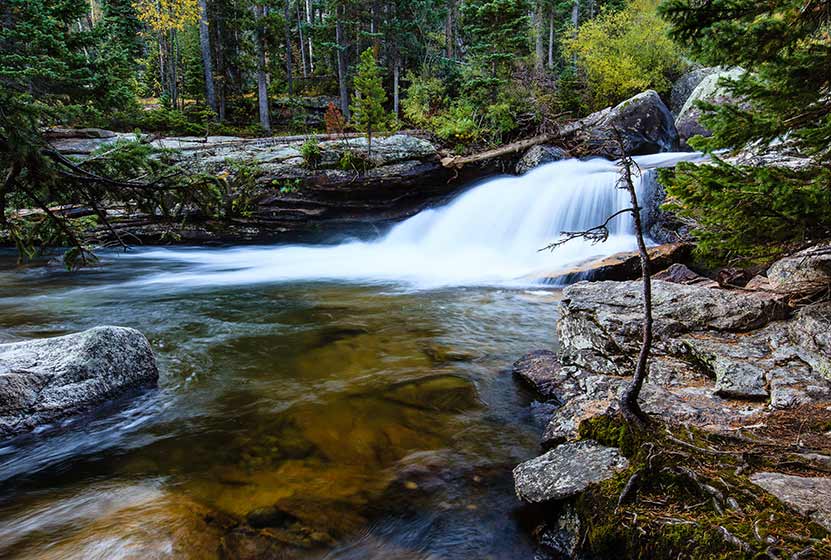
The trail then follows North Saint Vrain Creek, until it meets with a trail junction. The trail to the right leads past a series of backcountry campsites, and is a slightly more direct route to Thunder Lake and Fan Falls. However, the left-hand trail is not much longer and takes hikers past two more waterfalls, Calypso Cascades and Ouzel Falls. The rest of this trail profile will explain this route.
Having taken the left-hand trail, it will soon cross a hefty log bridge spanning North St. Vrain Creek. Stop here to enjoy an unnamed set of cascades. Soon the trail will meet with a second trail junction at Calypso Cascades. The right-hand trail leads hikers to the cascades, over another bridge that crosses Cony Creek at 1.8 miles, then weaves up a set of switchbacks to Ouzel Falls at 2.7 miles.
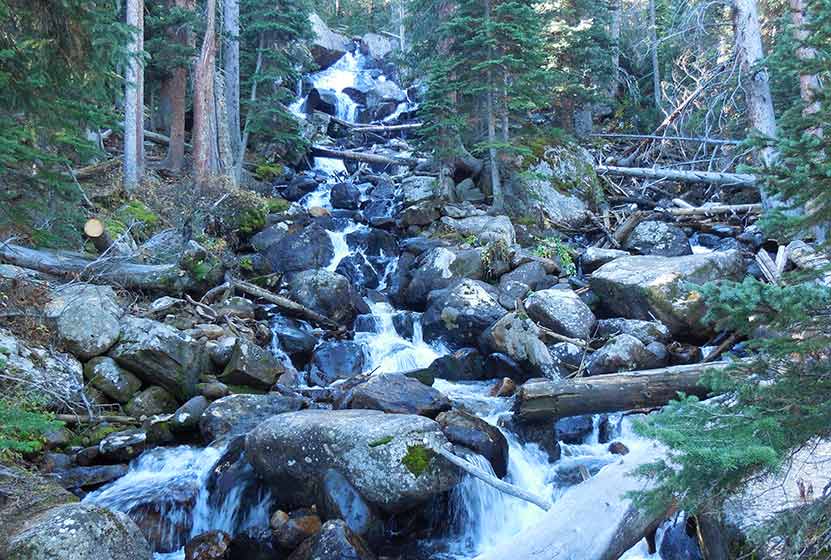
After Ouzel Falls, the trail comes to a junction with the Bluebird Lake trail at 3.7 miles. However, the way to Fan falls passes by this junction and keeps going straight/northwest. In approximately 1.5 mile from the Bluebird Trail junction @ 5.2 miles into the hike, the trail makes a final split. The right leads up to the Lion Lakes and to Thunder Falls. The trail to the left leads up to Thunder Lake, and off-trail access to Fan Falls, and Falcon Falls.
At Thunder Lake, the way to Fan Falls requires some listening and attention to the landscape. Hikers should be familiar with backcountry travel and land navigation because this remaining segment requires hiking on unmarked and lesser traveled social trails. Hiking along the right/north side of the lake, a social trail leads back into the forest. When the trees open up into a clearing, the sounds of Fan Falls become apparent. Following the sound of the waterfall and the creek, hikers can pick their way through rock, brush, and deadfall until reaching the base of Fan Falls.
Here at Fan Falls, Falcon Falls can be seen approximately 1/4 of a mile to the the northwest. Falcon Falls is formed by a creek that spills out of Falcon Lake, a small alpine lake located about 600' above Thunder Lake. The hike over to Falcon Falls requires first descending to where the landscape is not so steep and rocky, as a lateral hike would require travel through steep and difficult terrain. After descending to less steep terrain, look for the social trail that leads over to the creek flowing out of Falcon Lake. Hiking along and up the creek that flows out of Falcon Lake, through rock and thick brush, hikers will emerge at the base of Falcon Falls. This makes for an 8 to 8.25 mile one-way hike from the Wild Basin Trailhead.
Tips & Resources for Hiking to Falcon Falls in RMNP
- TIP: A patrol cabin is located on the northeast shore of Thunder Lake. Though kept locked, the eaves can offer some limited shelter from afternoon rainstorms.
- Camping: The Thunder Lake campsite and others along this route can be reserved through the Rocky Mountain National Park Wilderness Offices. Because this is an extensive hike in rugged country, it may be wise to make this expedition a part of a multi-day trip.
- TIP: There are food storage lockers available at the Wild Basin, Finch Lake, and Sandbeach Lake Trailheads. These are required for visitors staying overnight.
- Get there early: Parking may be somewhat limited as with many hikes in RMNP area and can get full even early in the morning.
- You're in Bear Country: Black Bears live in the Wild Basin area and are active on the months of April through November. Be aware, and dispose of your food responsibly.
- Recommended Map for Rocky Mountain National Park & Falcon Falls: The trail maps provided by Rocky Mountain National Park are usually sufficient. However, for the hike up to Fan Falls, we highly recommend purchasing a National Geographic Trails Illustrated Map.
- Packing List: Always pack the 10 Essentials. Download our Hiking Guide to get list and dayhiking packing checklist.
- Colorado Road Conditions: Colorado Road Conditions
- Photo: We would like to express our gratitude to Sam Cox for sharing such an amazing photograph of this hike to Falcon Falls in RMNP.
- After the Hike: Rock Creek Tavern & Pizzeria
Weather
Map & Driving Directions
Click for Driving Directions